
Manually cleaning data is no easy task. It involves a lot of effort and precision.
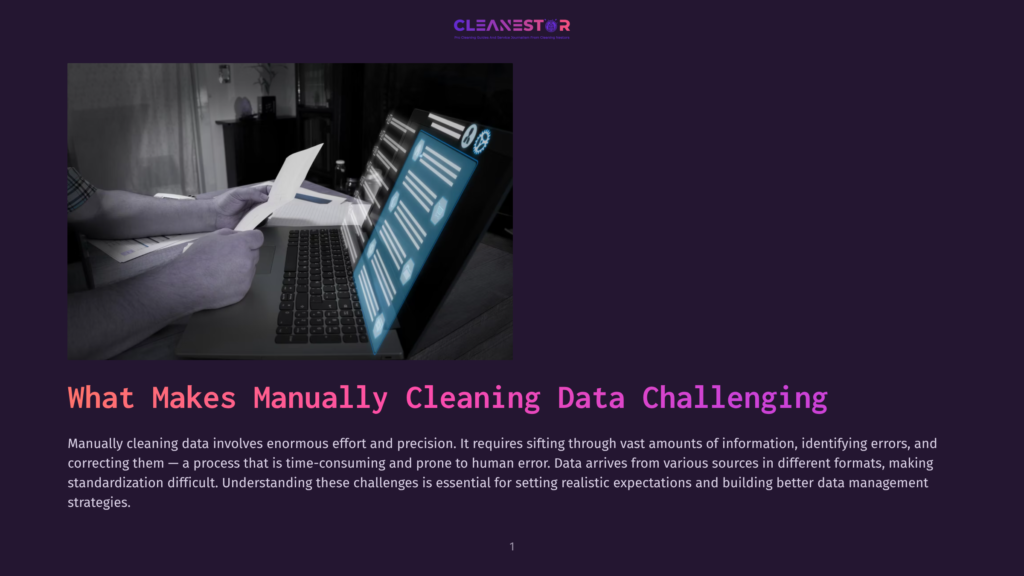
This process is crucial for ensuring data accuracy and reliability. But why is it so difficult? The task of manually cleaning data can be overwhelming. It often requires sifting through vast amounts of information, identifying errors, and correcting them. The process is time-consuming and prone to human error.
Even a small mistake can lead to significant issues down the line. Additionally, data comes from various sources and in different formats. This diversity makes it hard to standardize and clean the data effectively. Understanding these challenges is important for anyone working with data. It helps in setting realistic expectations and preparing better strategies for data management.
Introduction To Data Cleaning
Cleaning data is a crucial step in data processing. It involves identifying and correcting errors and inconsistencies. This process ensures the data is accurate and reliable. Let’s explore why this task is challenging and its importance.
Importance Of Data Quality
Data quality affects decision-making. Poor-quality data can lead to wrong conclusions. It can also cause financial losses. High-quality data, on the other hand, provides a solid foundation for analysis. It helps in making informed decisions. Businesses can trust the insights derived from clean data.
| Aspect | Impact |
|---|---|
| Accuracy | Reduces errors |
| Completeness | Ensures no information is missing |
| Consistency | Maintains uniformity across datasets |
Role Of Data Cleaning
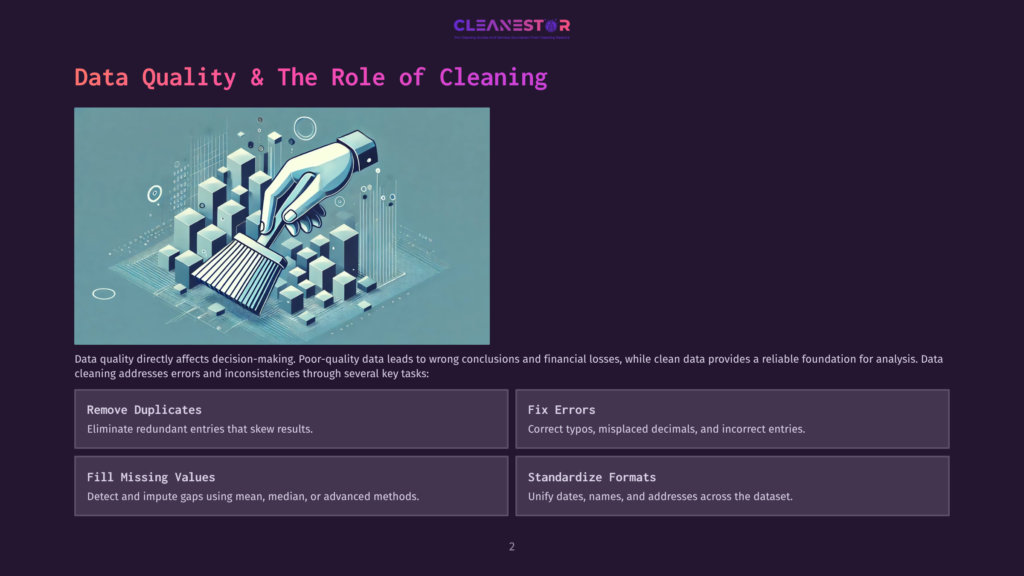
Data cleaning involves removing errors and inconsistencies. It makes data usable and reliable. This process has several steps. Each step addresses a different issue. Here are some common tasks in data cleaning:
- Removing duplicate entries
- Fixing typos and errors
- Filling in missing values
- Standardizing formats
Each of these tasks requires attention to detail. They ensure the data is accurate and consistent. Manual data cleaning can be time-consuming. It requires a deep understanding of the data. But, it is essential for reliable analysis.
Volume Of Data
The volume of data in today’s digital age is staggering. Businesses collect massive amounts of information daily. This vast amount of data can be overwhelming. Handling it manually poses significant challenges. Let’s explore these challenges in detail.
Handling Large Datasets
Large datasets are difficult to manage. They require significant storage space. Searching through them can be slow and tedious. Mistakes can easily occur. Ensuring accuracy becomes a major task. Tools and software can help, but they are not always foolproof.
Time-consuming Processes
Manually cleaning data takes a lot of time. It involves checking each data point. This can be very slow and repetitive. Employees may spend hours just on data entry. Errors are common due to fatigue. This impacts productivity and efficiency.
Automating parts of the process helps. But full automation is often not possible. Human oversight is still needed. This adds more time to the overall process. It becomes a cycle of continuous monitoring and correction.
Data Inconsistencies
Manually cleaning data can be a daunting task due to various challenges, one of the most significant being data inconsistencies. These inconsistencies can arise from various sources and can take different forms, making the process complex and time-consuming.
Identifying Errors
Errors in data can come from multiple sources. Typos, missing values, or incorrect data entries are common. Identifying these errors is crucial but often difficult. A simple misspelling or misplaced decimal can lead to significant issues. For instance, “John Doe” and “Jon Doe” might refer to the same person but will be treated as different entities.
Using tools like Excel or Google Sheets, you can highlight and correct these errors. But the process is manual and labor-intensive. Here is a quick method to spot duplicates:
=IF(COUNTIF(A:A, A2)>1, "Duplicate", "Unique")
Standardizing Formats
Data often comes in various formats. Dates, addresses, and names can be represented differently. Standardizing these formats is essential for accurate analysis. For example, dates can appear as “MM/DD/YYYY” or “DD-MM-YYYY”. Converting all dates to one standard format ensures consistency.
You can use functions in spreadsheets to standardize these formats. For dates, the TEXT function in Excel can be helpful:
=TEXT(A1, "MM/DD/YYYY")
Standardizing text is also vital. Names, for instance, should follow a consistent format. Whether “First Last” or “Last, First”, choose one format and apply it across the dataset.
Here is a simple example of standardizing text format in Excel:
=PROPER(A1)
These steps ensure data is clean and ready for analysis. Remember, consistency is key.
Missing Data
Manually cleaning data can be a daunting task, especially with missing data. Missing data creates gaps that can disrupt analysis. These gaps may cause inaccuracies and hinder decision-making. Understanding how to handle missing data is crucial for any data professional.
Detecting Gaps
Detecting gaps in data is the first step. Missing values can be subtle. They might appear as empty cells or placeholders. Identifying these gaps accurately is essential. Tools like Excel or programming languages like Python can help. They offer functions to detect missing entries. Yet, manual detection remains challenging. Human error can lead to overlooked gaps. This can affect the overall quality of the dataset.
Methods Of Imputation
Once gaps are detected, the next step is imputation. Imputation means filling in the missing values. There are several methods to do this. One common method is mean imputation. This involves replacing missing values with the mean of the available data. It’s simple but may not always be accurate.
Another method is using the median or mode. Median imputation is less affected by outliers. Mode imputation is useful for categorical data. More advanced methods include regression or machine learning algorithms. These methods predict missing values based on other data points. While more accurate, they require more resources and expertise.
Data Duplication
Data duplication is a common challenge in data management. It occurs when the same data is entered more than once in a database. This problem can lead to inconsistencies and inaccuracies in data analysis. Manually cleaning duplicated data is time-consuming and error-prone. Let’s explore why this is so challenging.
Finding Duplicates
Identifying duplicates in a large dataset is not easy. Each duplicate may not be an exact match. Variations in spelling, formatting, or data entry errors complicate the process. For instance, “John Doe” and “J. Doe” might refer to the same person. Without automated tools, spotting these duplicates requires meticulous attention to detail.
Resolving Redundancies
Once duplicates are found, resolving them is another hurdle. Deciding which record to keep and which to delete is crucial. This decision affects data accuracy and integrity. Inconsistent data entries make this process even harder. For example, one record may have a complete address while another only has a partial address. Merging these records without losing important information is challenging.
Complex Data Structures
Dealing with complex data structures can be a headache. This challenge often arises in the realm of data cleaning. Complex data structures can be intricate and messy. Understanding and cleaning them requires time and effort. Below we explore two common issues: nested and hierarchical data, and unstructured data challenges.
Nested And Hierarchical Data
Nested data contains multiple levels within a single record. For example, a customer record might include purchase history, each with individual items. Each item has its own attributes like price and quantity. This layering makes it hard to access and clean.
Hierarchical data adds another layer of complexity. It involves parent-child relationships. Think of an organizational chart. Managers (parents) have employees (children). Cleaning such data means you must keep these relationships intact. Breaking these links can lead to data loss or errors.
Unstructured Data Challenges
Unstructured data lacks a predefined format. Emails, social media posts, and customer reviews fall into this category. This data is rich in information but messy. Cleaning it involves extracting relevant pieces and discarding the rest. This task is time-consuming and prone to errors.
Text data can be ambiguous. Words have different meanings based on context. Identifying and correcting these nuances is difficult. This makes the data cleaning process even more challenging.
Tool Limitations
Manually cleaning data can be a daunting task. Tool limitations pose significant challenges. These limitations can stem from various factors.
Software Constraints
Many data cleaning tools have restrictive features. They might not support all data formats. This makes it hard to clean diverse datasets. Limited customization options also hinder the process. Users can’t tailor the tools to their specific needs. Some software lacks advanced functionality. This forces users to perform repetitive tasks.
Need For Manual Intervention
Automated tools can’t handle all data issues. Manual intervention becomes necessary. Tools often miss subtle errors. They can’t detect context-specific problems. Users must manually review and correct these errors. This process is time-consuming. It requires a good understanding of the data. Users need to identify patterns and inconsistencies. This adds a layer of complexity to data cleaning.
Human Error
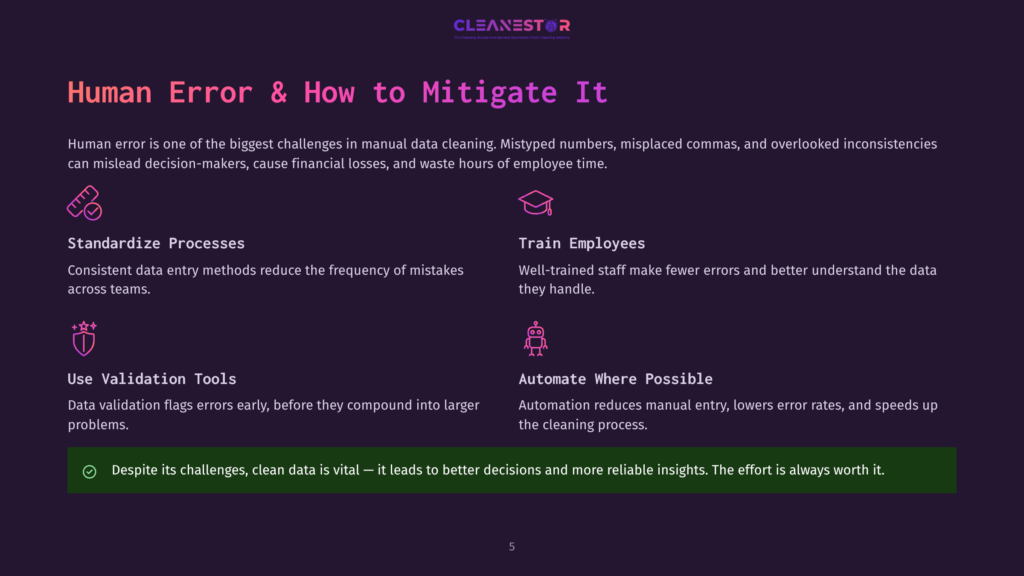
Human error is one of the biggest challenges in manually cleaning data. People make mistakes. They mistype numbers. They misplace commas. These small errors can lead to big problems. Data quality suffers. Insights become unreliable. Projects get delayed.
Impact Of Mistakes
Errors in data entry can cause serious issues. Incorrect data can mislead decision-makers. This can affect business strategies. Missteps in data can lead to financial losses. Companies might lose trust in their data.
Mistakes can also waste time. Correcting errors is time-consuming. Employees spend hours fixing data. This time could be better used elsewhere. Efficiency drops. Productivity suffers. The cost of human error adds up quickly.
Mitigating Risks
There are ways to reduce human error in data cleaning. Standardizing data entry processes helps. Consistent methods reduce mistakes. Training employees is also crucial. Well-trained staff make fewer errors.
Using data validation tools can catch mistakes early. These tools flag errors before they become big problems. Implementing regular audits ensures data quality. Regular checks help find and fix errors quickly.
Automation can also help. Automated systems reduce the need for manual entry. This lowers the chance of human error. Automation makes data cleaning faster and more accurate.
Frequently Asked Questions
Why Is Manual Data Cleaning Important?
Manual data cleaning ensures accuracy by identifying and correcting errors. It improves data quality, making it more reliable for analysis.
What Are Common Data Cleaning Challenges?
Common challenges include identifying inconsistencies, handling missing data, and removing duplicates. These tasks can be time-consuming and labor-intensive.
How Does Manual Data Cleaning Improve Analysis?
Manual data cleaning improves analysis by ensuring data accuracy. Clean data leads to more reliable, insightful, and actionable results.
What Tools Help With Manual Data Cleaning?
Tools like Excel, OpenRefine, and Python libraries assist with manual data cleaning. They help identify and fix data issues efficiently.
Conclusion
Manually cleaning data presents many challenges. It requires time, patience, and accuracy. Errors can slip through unnoticed, causing issues later. Complex data sets make the task even harder. Consistency is crucial but tough to maintain. Specialized skills are often necessary for proper cleaning.
Despite its challenges, clean data is vital. It leads to better decisions and insights. Understanding these challenges helps in improving data practices. Investing in automated tools can also ease the burden. The effort spent on clean data is always worth it.
As an Amazon Associate, Cleanestor earns from qualifying purchases at no additional cost to you.